Planning for how to address the COVID slide, or even a COVID slowdown, is challenging given the undefined path of the next few months, but one thing that is certain is that data will play a more critical role than ever in efficiently and effectively planning to make up for lost time and learning. The key questions many are looking to answer – which data to use, when to collect the data, and what to do with the data. While no consensus has been reached, a number of ideas and strategies are emerging that capture how schools plan to use current and future data to attack this learning slide.
Read MoreOn April 15, EdOps published “Budget Considerations from COVID-19,” detailing planning considerations that LEAs might apply to their contexts when budgeting for SY20-21. This post is a follow-up to share the planning efforts of specific LEAs on DC’s Deputy Mayor for Education’s Contingency Education Budget Planning Response Work Group. The intention of this post is to facilitate knowledge sharing among public charter school LEAs as they prepare their SY20-21 budgets.
Read MoreA successful first day of school begins months before the first day of classes. Schools with strong data practices typically begin initial Student Information System (SIS) planning and preparation during the spring of the prior school year. A staff member or team coordinates the completion of major tasks so that the student information system is ready for use by the first day of school. We recommend this sample timeline to get you started and highlight four things that can derail these plans.
Read MoreThe Finance Committee leads the Board of Directors in performing its fiduciary duty to the nonprofit organization that runs the school. There are a number of key responsibilities that a Finance Committee must complete to support the school staff and the full board in their work.
Read MoreThis the second of our two-part series on best practices in board governance over academic performance. Part 1 focused on the responsibilities of an academic performance committee and the importance of creating a calendar around reviews of school performance. In this post, we delve further into how strong boards review school performance, as well as common metrics and visualizations that can help boards easily understand their student performance data. A board’s goal should look for ways to understand the trends in academic performance throughout the year, not just in a once-per-year snapshot when state assessment results are published.
Read MoreMuch is unknown about the impact or the duration of the COVID-19 crisis. In coordination with the D.C. Deputy Mayor for Education’s Contingency Education Budget Planning Response Work Group, EdOps led the development of potential revenue and expense implications the pandemic may have on local education agency (LEA) budgets. LEAs are encouraged to apply these considerations to their contexts.
Read MoreAs recommended by Education Board Partners in Standards for Effective Charter School Governance, the top priority of effective boards should be to ‘focus relentlessly on student achievement.’ Schools are in the business of providing top-notch education to students, and school boards should prioritize this principle in their work.
Read MoreA personnel file audit is the periodic and systematic review of your personnel files to assess whether the documents in each employee’s personnel file are accurate, up to date, and complete. The audit helps ensure legal compliance, identifies HR process weaknesses and highlights HR successes.
Read MoreAs a follow-up to last week’s post on strategies for improving attendance, this week we have a short post with suggested roles for everyone involved in the attendance management process. Defining roles is a key step in establishing your school-wide attendance plan.
Read MoreThe pathway to strong school attendance begins at the end of the previous school year and goes through September. Establishing an attendance plan during this time sets the foundation for the school year and is critical in forming positive habits toward meeting your annual attendance goals.
Read MoreThroughout the year OSSE and PCSB ask schools to “validate” a number of student data points – from re-enrollment rates to PARCC achievement subgroup scores. Schools are asked to review and certify certain groups of data in OSSE’s or PCSB’s databases and confirm their accuracy (versus the school’s internal records). While data validation can feel daunting, making a roadmap at the beginning of the school year allows you to streamline validation task management during the school-year when there are so many competing priorities.
Read MoreSchools are taking more assessments than ever before. While the output and data from assessments vary – RIT scores and percentiles from NWEA MAP or a percent score from Achievement Network – common challenges exist for school leaders, regardless of the exam. School leaders are all aiming to create meaning from student scores and put interim scores in context with end-of-year outcomes. This post identifies one method (of many) that will help leaders make sense of current assessment results and what they imply about end-of-year outcomes.
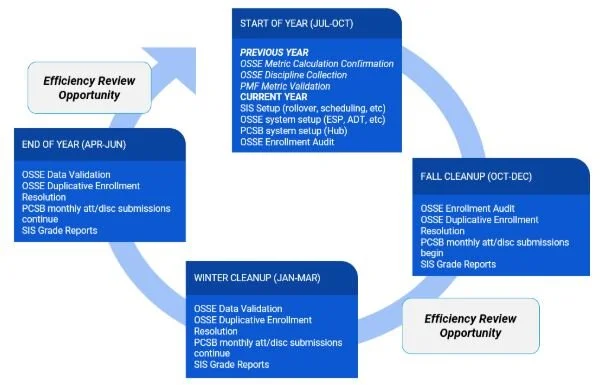
Read MoreData systems are great at making our schools run more efficiently… right up until a grade is missing on a report card or a student can’t log in on test day. As the web of interconnected systems grows in size and complexity, keeping your data clean and orderly is just as important as any software upgrade.
Read MoreWhen thinking about financial compensation, most employees only consider salary. As an employer, however, you know that your financial contribution to staff is much greater than that. If you can better communicate the full value of staff compensation, you can improve both employee engagement and retention.
Read MoreThe benefits offered by your school can directly affect employee retention. In an earlier post, we covered flexibility benefit options, which account for four of the top valued benefits according to research from Harvard Business Review. Today, we are moving down the list to student loan assistance and tuition assistance.
Read MoreEffectively analyzing school financial statements across multiple years can be challenging. Changes in facilities, organizational structure, fundraising strategies, or student population (including opening or closing campuses, adding new grade levels, or experiencing demographic shifts) complicate the comparability of financials.
Read MoreLenders want to know if you will pay them back. Whether you are considering traditional bank loans, taxable or tax-exempt bonds, or even special forms of financing created by state or federal government programs, the underlying question is the same. To find the answer, lenders look for assurances that your project and school will generate enough cash flow to service the debt (and that your school will stay open long enough to pay).
Read MoreA well-conceived budget will serve as a “map” when making financial decisions throughout the year. It will reflect what you value as an organization, communicate your priorities to key stakeholders (board, staff, authorizer, families, funders), and highlight any new or changed priorities. Before the more technical work of the budgeting process begins, there are a number of broad concepts that we recommend every school focus on.
Read MoreAssessment data comes in fast throughout the year and provides multiple opportunities for all stakeholders to learn about the performance of a school. With so many ways to slice the data, it can be difficult to identify the most important stories.
Read More