
Maximizing Impact: Strategic Budgeting and Federal Funding for FY27
As we head into the FY27 budget season, charter school leaders and boards are once again tasked with a critical challenge: ensuring that every dollar spent directly supports student achievement while maintaining long-term financial sustainability.
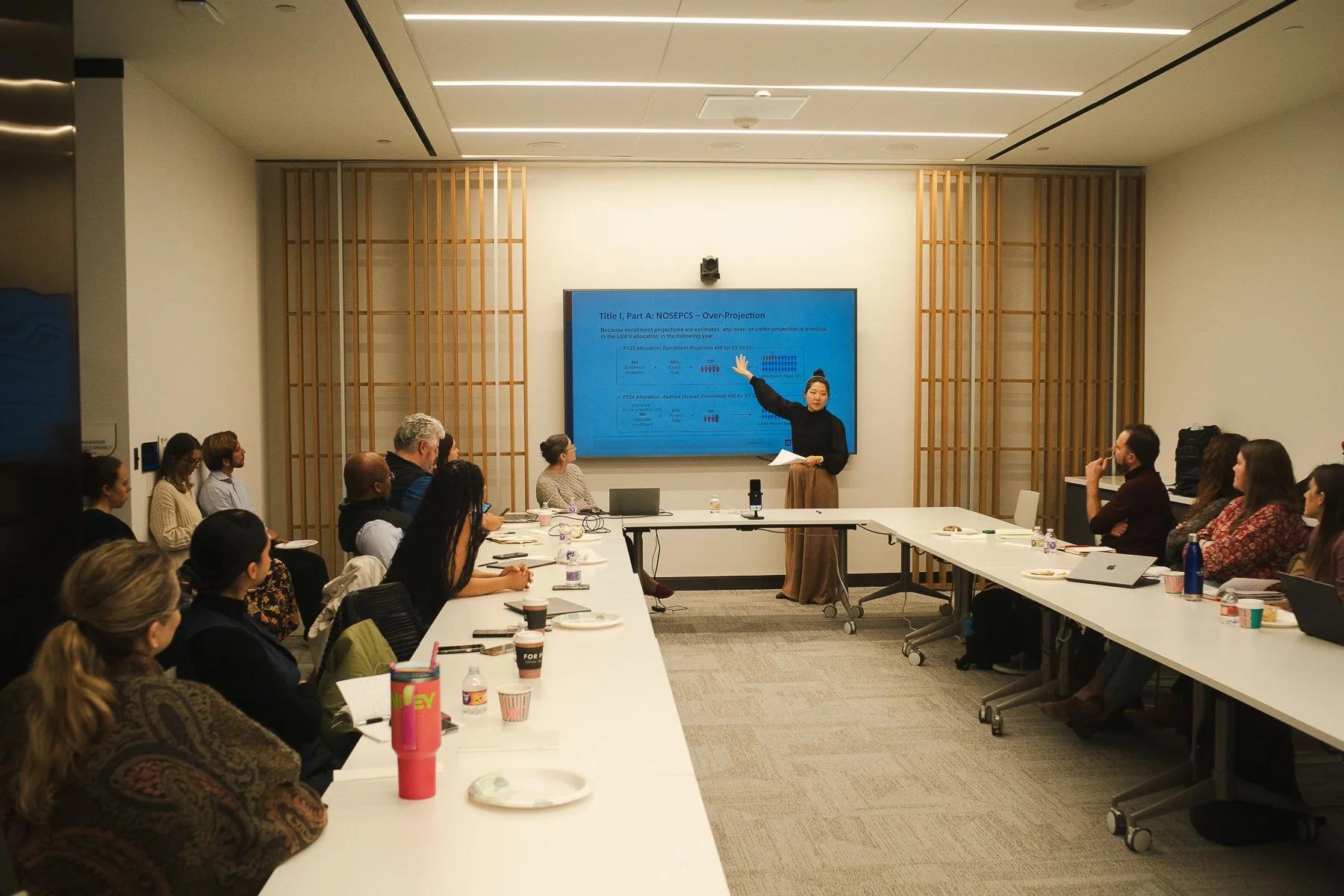
At our recent EdOps Lab (pictured below), we brought together financial experts and state leadership to dive deep into the mechanics of high-impact budgeting. From operational best practices to long-term facility planning and the intricacies of OSSE federal grant allocations, the session provided a roadmap for schools to navigate the upcoming fiscal year with confidence.
1. Best Budgeting Practices for FY27
A budget is more than a financial document; it is a "map" for decision-making that should reflect your school’s unique values and programmatic priorities. Success begins with a structured process, typically moving through three key phases:
Phase 1 (Determine): Executive Directors and Boards set priorities and targets.
Phase 2 (Develop): Finance Directors build the draft model with departmental input.
Phase 3 (Demonstrate): Finance Committees and Boards review for final approval.
Key Drivers and Scenarios
Because over 90% of charter school funding is typically driven by enrollment, it is vital to align on key assumptions early. We recommend testing your budget’s sensitivity through Scenario Planning—proactively planning for different levels of enrollment so you aren't caught off guard by shifts in student re-enrollment or recruiting success.
2. Strategic Facilities Considerations
The annual budget season is the ideal time to evaluate existing arrangements and, if a future event is identified within the next 2-3 years, build a multi-year pro forma to guide major decisions. Facilities expenses often account for up to 20% of the operating budget. These are significant fixed costs that are difficult to change, and strategic planning for any decision impacting your facilities arrangement must begin at least two years in advance.
Keep in mind the difference between operating and capital expenses when quantifying the impact of a future facilities decision on future financial metrics. Effective facilities budgeting requires a sharp distinction between operating expenses—recurring costs like utilities, janitorial services, interest, and noncash depreciation—and capital expenses, which represent long-term investments like building acquisitions or major renovations. The accounting treatment of operating and capital expenses varies, which impacts the bottom line and key financial ratios.
To maintain financial health, schools must rigorously monitor lender covenants such as the Debt Service Coverage Ratio (DSCR) and Days Cash on Hand (DCOH). The exact covenant calculation and minimum requirement can vary by lender, and it’s critical to review the specific covenant language to ensure accuracy. Since missing these targets constitutes a loan default, build in a budgetary cushion to absorb potential shortfalls in enrollment or funding. Additionally, maintain a cash cushion to support future capital expenses necessary to maintain your building.
Finally, look beyond the budget year when reviewing your lease or loan schedule. Flag future changes and key dates - such as the expiration of lease abatement period or the transition from interest only to amortizing loan payments - that could materially increase future operating expenses. Ensure your near-term budget positions the school well to weather these future structural changes without compromising educational mission.
3. Federal Funding Insights from OSSE
We were honored to have Linda Sun, Director of Federal Programs and Strategic Funding at OSSE, join us to explain the Title I, Part A allocation formula. Understanding how these federal dollars flow is essential for accurate revenue forecasting.
How Title I-A Allocations Work
OSSE retains up to 1% for state administration and 7% for school improvement grants targeting the District's lowest-performing schools. The remaining 92% (minimum) passes through directly to eligible LEAs.
Eligibility: The threshold in DC is typically between 35% and 40%, shifting annually based on demographics.
Poverty Share: The formula is designed to provide the most funding to LEAs with the highest concentrations of low-income students.
Hold Harmless Provision: To provide stability, LEAs that become ineligible can still receive at least 85% of their prior-year allocation for up to four consecutive years.
New or Expanding Charters (NOSEPCS)
For new or significantly expanding schools, OSSE calculates poverty shares based on submitted enrollment projections. It is important to note that these are trued up the following year based on audited actual enrollment to account for any over- or under-projections.
Moving Forward to FY27
Strategic budgeting requires constant monitoring. We recommend reviewing a monthly KPIs dashboard, actuals-vs-budget variances, and updated cash flow forecasts. By asking the right questions now, your school can ensure it remains financially healthy and focused on student achievement for years to come.
Need support with your FY27 budget or facilities pro-forma? Reach out to info@ed-ops.com to connect with the EdOps finance team!