
Setting Your Own Targets Under DC PCSB’s New Financial Oversight Policy
DC PCSB’s new Financial Oversight Policy sets a floor for each Key Financial Indicator (KFI), the point at which DC PCSB increases its oversight of a school. The floors are not designed to serve as a school’s financial goals. We think the more useful conversation for boards and finance leaders is about targets that fit their own school: what it plans to do over the next few years, what it may need to build or finance, and how much cushion it wants for the unexpected.
DC PCSB adopted the policy on September 28, along with the 2026-27 School Financial Oversight Guidance that explains how it will be applied. On October 22, EdOps hosted an EdOps Lab with DC PCSB to walk school leaders and finance teams through the changes. Joanna Han and Valeria Sanders presented for DC PCSB, EdOps Finance Team covered the new KFIs, and Laura Schilling of our Data Team closed with a session on reading your own enrollment data. Here is what we want every school and board to take away.
Five floors instead of one score
The prior Financial Analysis Report combined eight indicators into a score out of 100. DC PCSB now assesses five economic viability KFIs separately, each against its own floor:
Two-Year average Adjusted Operating Surplus (AOS) margin: −3%, together with a declining trend in Days Cash
Days Cash on Hand: 30 days
Current Ratio: 0.9
Three-year Weighted Enrollment Variance: −20%
Debt Covenant Violations: Floor - N/A, Unwaived violations trigger oversight
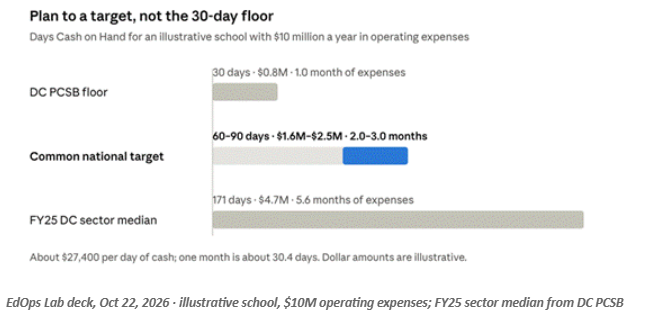
A floor is where DC PCSB increases oversight, not a level to plan to. A school that budgets to the floor can fall below it with an ordinary variance.
Set your own targets, based on what your school needs
We suggest each board approve a target for each KFI when it approves the annual budget, then review progress against those targets at each finance committee meeting. These are the ranges EdOps suggests as a starting point:
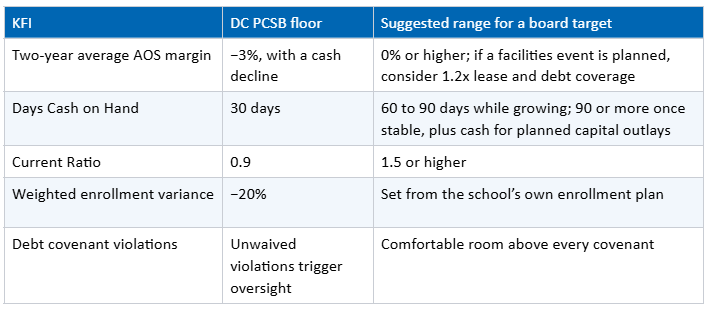
The right target depends on the school’s plans. A school preparing for a facility project or new loan needs more cash and a larger surplus than one with stable enrollment and a long-term lease in a recently renovated building, where near-term capital needs are low. A school adding grades needs cash for costs that arrive before the enrollment revenue does. Either way, the board should set each target deliberately and tie it to the strategic plan. One caution on days cash on hand: board-designated reserves signal intent, but they still count as unrestricted cash, so lenders and authorizers will include them in the calculation.
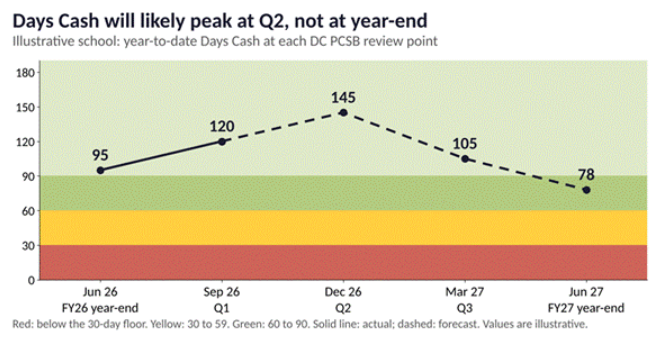
Days Cash: read Q2 against the year-end forecast
Days Cash keeps its formula, but DC PCSB now reviews it six times a year, and each review is a year-to-date calculation. At Q1, DC PCSB compares September 30 cash with July through September operating expenses, less depreciation, over the 92 days elapsed. At year-end, it uses the full year and 365 days.
Because a larger share of per-pupil funding arrives by the Q2 payment (60% PPF and 100% PPFF), Days Cash at Q2 will likely be higher than the school’s year-end position, and a strong Q2 result should not be read as the year-end result. We recommend that boards review Days Cash every quarter alongside the projected year-end result, and set the target against year-end.
AOS: operating within your means, and planning ahead
AOS replaces the prior change in net asset margin, 3-year margin, and cash flow from operations margin measures. It adjusts your net income for depreciation and other noncash operating expenses, finance lease principal payments, and in-kind donations.
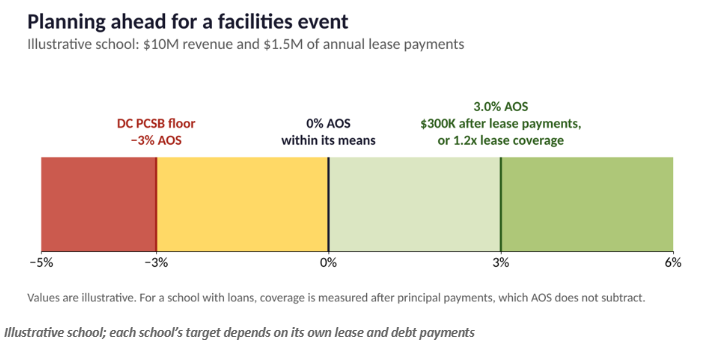
DC PCSB no longer requires positive net income, and a 0% AOS means the school operated within its means for the year. A school planning a facilities event, such as a future purchase, renovation, or new lease, will want a higher target. Lenders commonly look for at least 1.2x coverage, meaning net income available for lease and debt payments is at least 1.2 times those payments. Because AOS doesn’t subtract loan principal, a school that already carries a loan should measure coverage after principal payments, not from AOS alone.
The new economic viability standards won’t be applied to the FY26 audit, but FY26 still counts. The first AOS result, issued with the FY27 audit review in December 2027, averages FY26 and FY27, so your FY26 audit is already half of that result.
What the new measures show
We compared two anonymized schools: School A, a growing K-8 school in a subsidized facility, and School B, a fully enrolled K-5 school in a recently renovated, leased facility.
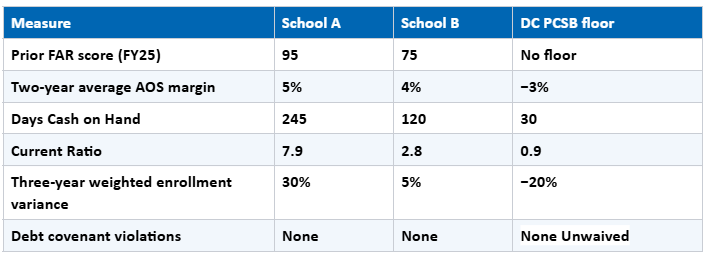
School B lost points under the prior FAR, but both schools clear every floor under the new KFIs by a wide margin. The floors alone tell a board little; what matters is whether the school is meeting the targets its own plans require.
Enrollment: the trend now matters more than the forecast
The new enrollment KFI measures year-over-year change in enrollment, not performance against budget. It uses four years of audited enrollment to calculate three annual changes, weighted 60% for the most recent, 25% for the prior year, and 15% for the oldest. Planned changes, such as dropping a grade, still lower the result, so tell DC PCSB about them before the October enrollment review.
Valeria Sanders from PCSB explained that DC PCSB reviews FY28 projections using grade progression ratios, entry-grade trends, and LEA and sector trends for special populations. Laura Schilling from EdOps Data’s advice was to get ahead of both reviews by looking back at least three years at your own cohorts, who is leaving and when, and whether special populations projections match actual needs. Public sources from OSSE, EdScape, and the DC School Report Card answer all three. They also reminded us that accurate enrollment projections are separate from the new KFI that measures actual changes in enrollment each year.
What boards can do now
We suggest five steps this year: approve a target for each KFI with the budget; build the FY28 budget to those targets rather than the floors; review every KFI at each finance committee meeting, with the projected year-end result beside each quarter; plan five years ahead for enrollment changes, capital replacements, and lease or debt dates; and document the purpose of your reserves.
Dates to plan around
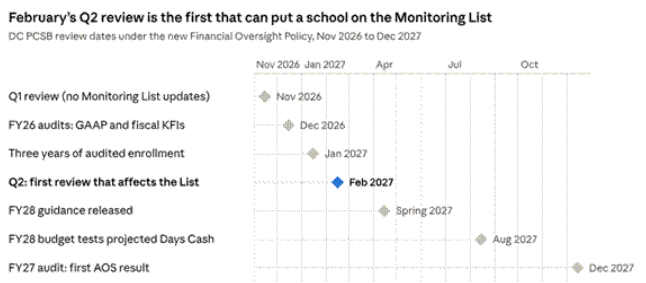
The November Q1 review is a practice run that won’t update the Monitoring List. February’s Q2 review is the first that can add a school to the list, and the first AOS result arrives in December 2027.
What EdOps is doing
A report in each school’s Financial Reporting Tool already shows each DC client’s results against every new floor. We are adding the new measures to monthly board slides, DC PCSB reporting templates, and our budgeting tool. Before the February Q2 review, your School Finance Manager will walk through your results and can help your board set targets that fit your plans.
Thank you to Joanna Han and Valeria Sanders of DC PCSB for presenting with us, to Ben Friedlander from EdOps Finance and Laura Schilling from EdOps Data for their sessions, and to the school leaders and finance teams who joined us and kept the conversation going at the lunch roundtables.
If you’re not an EdOps client and want to know where your school stands, email info@ed-ops.com and our DC Finance and Data teams will set up a time to talk.